Overview

Inside the box you get the power station itself, a mains charging cable, car charging cable and a DC5521 to DC5525 lead. There’s also a multilingual user manual.
There’s no solar charging cable and no protective cover. It’s disappointing that there’s no solar charging cable. Apart from the cost of purchasing an additional cable, it can also be a little confusing for new users to understand exactly what cable they need. I’ll cover this in more detail shortly.

The Delta 2 has a 1024Wh LFP or LiFePO4 battery and I was expecting it to be much heavier than it is. LFP batteries like this weigh more than equivalent standard Li-ion batteries that use NMC or Nickel Manganese Cobalt chemistry, but they support 3000 complete charge cycles compared to 500-1000 cycles for NMC batteries. The Delta 2 weighs 12 kg – only around 2 kg heavier than the Li-ion based Jackery Explorer 1000 which has a similar capacity battery and only 4 kg heavier than the 576 Wh EcoFlow River Max also based on Li-ion technology. It’s easy to move around with handles on either side, but it’s light enough to carry with just one handle. It’s a fairly compact unit measuring 211 x 400 x 281mm (W x D x H). A folding handle would have made it even more compact.
Like the EcoFlow River Max I reviewed a while back, the Delta 2 is well built, made of mostly hard plastic. It does feel a little more rugged than other power stations I’ve looked at with large slightly rubberised feet front and rear, that offer at least some protection as you move it around. There’s still no waterproof rating so you’ll need to be careful using it outside or invest in their optional waterproof bag.
The power station has a maximum output of 1800W and EcoFlow offers a few examples of what you could run and for how long on their website. Anything from a car fridge for up to 32 hours to an electric grill for just shy of one hour. I’ll have some real world examples shortly.
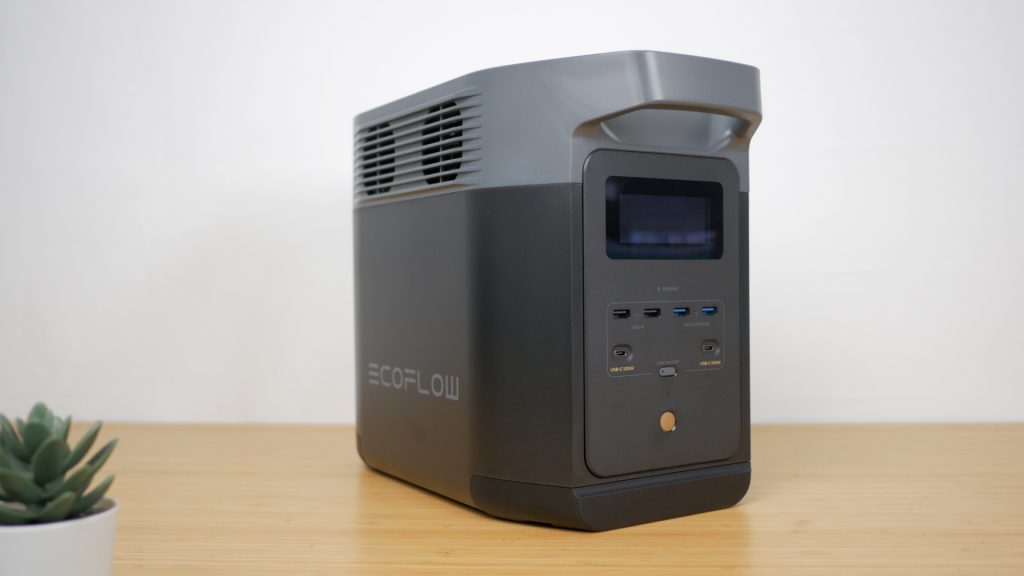
The Delta 2 doesn’t have the standard power station configuration. The display and ports are on the short ends of the unit. The front has the LCD display, 2 standard 12W USB ports and 2 blue 18W fast charging ports. Just below are two USB-C power delivery ports. Both these support a generous 100W of output simultaneously, which is a hugely useful configuration and not something I’ve seen before. So theoretically you could charge two of the latest 14” MacBook Pros at full speed at the same time. Even if you don’t have these requirements currently, this does offer future proofing for a significant purchase that you want to last for a long time. More and more devices use USB power delivery, which is slowly replacing cumbersome AC power bricks. Not just laptops, smartphones and tablets, but also drones and action cameras etc, and these ports are also useful for charging smaller portable power banks that often support high speed charging. Of course even higher power 140W USB-C ports that could replace a 16” MacBook Pro charger would be even better.

Around the back there’s the combined solar and car XT60 input, the mains charging port and the overload protection switch. With our oversized plugs, this UK unit has 4 pure sine wave AC sockets with 1800W of total output that can briefly surge to 2700W. The US version has 6 outlets. But even 4 is very useful and twice what you get on the much larger Bluetti AC200P I reviewed a few months ago.
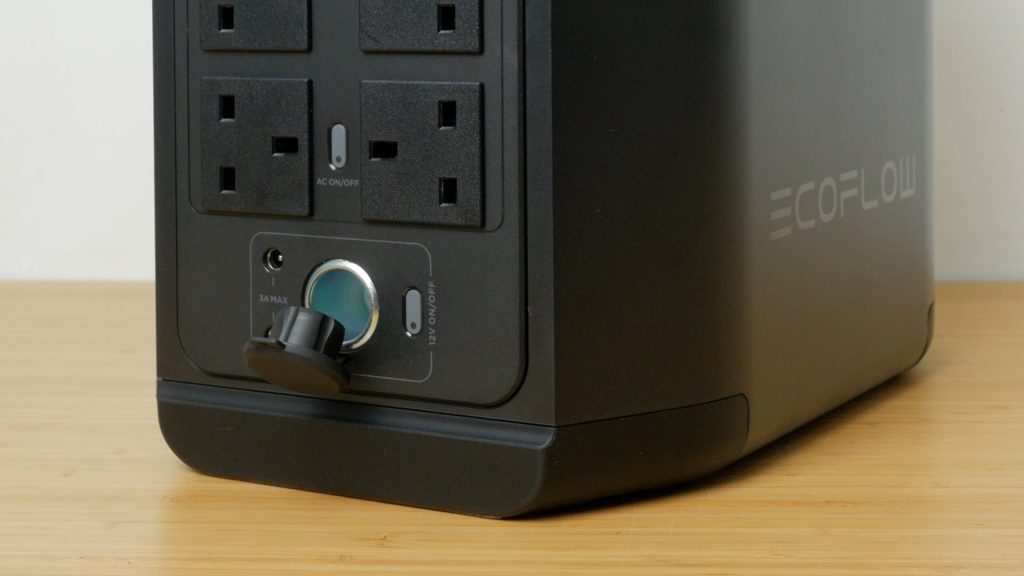
Below the AC sockets are the DC outlets: the 12.6V 10A or 126W car outlet and the two DC5521 12.6V 3A or 38W outputs.

All these outputs have their own power switch. You need to turn the unit on first with a short press of the power button. A long press turns it off. Then you need to turn on the USB, AC or DC subsystem afterwards. That’s understandable for the AC subsystem, which will drain the battery even if nothing is plugged in as I’ll test shortly. But with USB devices I found it a minor inconvenience having to remember to press this USB button whenever I wanted to charge my smartphone. I’d prefer the USB sockets just came on with the unit. You can sort of get around this though with the app, which I’ll also discuss shortly.

Both sides of the unit have cooling vents with intake and exhaust fans on either side. Finally there’s the beefy extra battery port on one side of the unit to connect the optional additional battery to double the capacity. Or you can add the Delta Max’s extra battery to triple the capacity. The extra battery costs almost as much as the Delta 2 itself but does weigh around 2.5kg less without all the additional electronics. You can’t use the EcoFlow Power Kit batteries unfortunately, which have a different connector.

The top of the unit is flat with a curved lip around the edges. This is intended for stacking the extra battery on top but it’s also useful for charging smaller gadgets without them rolling off.
It would have been nice to see some wireless charging pads on top like on the AC200P. And the unit is also missing any sort of LED light. I do find the floodlight on the Anker 757 I reviewed surprisingly useful. There are plenty of ports to add a light and a wireless charging pad, but it’s nice having it built in.
https://thetechnologyman.com/