Performance

The Delta 2 has a substantial 1800W inverter built in and can power most household devices with its 4 AC outlets. This is quite an achievement considering the weight and size of the power station. I confirmed their pure sine wave output, which is important for sensitive electronics with a graphical multimeter. These outlets can surge briefly to 2700W and also support EcoFlow’s X-Boost technology which can power devices rated at up to 2400W continuously by lowering the voltage.

It’s easier to understand with an example with this 2200W toaster and an energy monitor. With X-Boost off the Delta 2 will run this toaster at full power for around a minute then shut off with its overload protection kicking in.

The voltage here in the UK is around 230V. With X-Boost on I can run this toaster for as long as I need, but you’ll notice the voltage drops to around 210V and the actual output drops to the Delta 2’s true 1800W maximum output. And the toaster obviously won’t toast as quickly.
By default X-Boost is on, but I’d recommend turning it off and only switching it on as needed. Some devices may be sensitive to their voltage requirements so I would only use it if you have to. For example to run heating element based products like toasters and hair dryers, when there isn’t another option. I could just switch this toaster to 2 slot mode which is well within the rated output of the Delta 2. At least you can switch X-Boost off – on the Anker 757 it also reduced the voltage with devices exceeding its maximum output, but there’s no way to turn this feature off.

For the remaining tests I left X-Boost turned off. Around the house as well as the toaster, I was able to run a 1550W hair dryer, a Nespresso coffee machine and even a 2kW heater which ran continuously at almost 1900W, above the Delta 2’s 1800W maximum output. With the Delta 2’s 1024 Wh battery you would only be able to run this heater at full power for around 30 minutes.
And running these higher power devices, fan noise is quite noticeable. At full output it’s as noisy as when charging at full speed at around 58dB. But these fans are quieter at lower output than when charging and turn off completely below around 100W, which is important if you’re sleeping nearby. This might depend on the ambient temperature of the unit – my room is around 20°C.

Out in the workshop I tried various handheld and stationary power tools. The initial start up draw of some of these machines was too much for the unit. But it had no trouble running a Bosch angle grinder and a Festool router and circular saw. And it ran my Bosch 1800W sliding mitre saw. It did run my Record BS350 14” bandsaw and Scheppach TS2000 table saw after a fashion. They started up but didn’t run at full speed.

My 3kW compressor overloaded the unit. The unit beeps and the AC subsystem turns off. Overload flashes in red on the display. You can immediately turn on AC again with its power button.
It’s important to turn off the AC subsystem when it’s not needed. You can set a timeout in the app, but even on the default 12 hour timeout, the unit dropped from 100% to 83% without anything plugged in. That’s around 1.4% per hour. The app lets you configure this time out from 30 minutes up to 24 hours or you can turn off the timeout completely, which is useful for running very low power devices, so long as you’re able to easily top up the battery.

I tested the DC outputs starting with the 12V car outlet which has up to 10A output at 12.6V or 126W, which I confirmed with a load tester. Ramping this up to 13A set off the current overload protection.

Using the same load tester I confirmed the 3A maximum output of the 12.6V DC5521 ports. I left this subsystem on for 12 hours with the battery at 100% and the battery remained at full capacity.

So if you have tech that can run directly off DC, it makes more sense to try and use these ports. You can set a timeout for this subsystem too in the app. All these DC outputs are regulated.
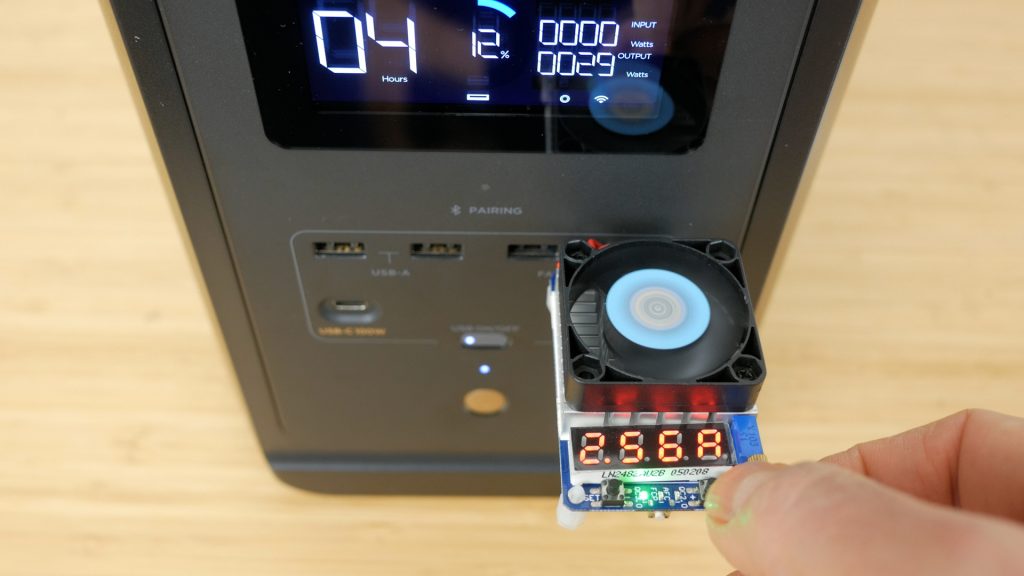
The 6 USB ports should cover most of your needs. There are two standard 12W 2.4A USB ports and two 18W fast charging ports that support Qualcomm Quick Charge 3.0. I tested all these ports with a USB load tester and got over 2.5A at 12V or 30W out of the fast charging ports, before overcurrent protection kicked in so a fair bit better than spec’d.

The two USB-C ports both support a full 100W of USB power delivery output. This portable jump starter can charge at the full 100W. And I’m charging a Lenovo Chromebook with the other port which can charge at up to 45W over USB power delivery.
One nice feature of this power station is that if you can change the Unit Timeout in the app to Never the USB ports remain active even when supplying tiny amounts of power, just like a mains wall charger. Some power stations shut off their USB ports when a device is fully charged which is no good if you want to keep a device topped up and ready to go.

For example this Olight torch has a reassuring green light on the magnetic charger when it’s fully charged. If the USB outputs shut off you’d need to reinsert the charging lead to check if the torch is fully charged.

The Delta 2 also has a UPS or uninterruptible power supply function which is a very useful feature I’ve really come to rely upon. When the power station is charging off mains, any mains devices you plug in will bypass the power station and run directly off mains until there’s a power cut, when they’ll switch across to the power station’s battery. EcoFlow quotes a 30ms switchover which I found good enough for a desktop computer, but they warn against using this feature for data servers that might require 0ms switching.
All 13 ports support passthrough charging and can be used whilst the unit is charging.
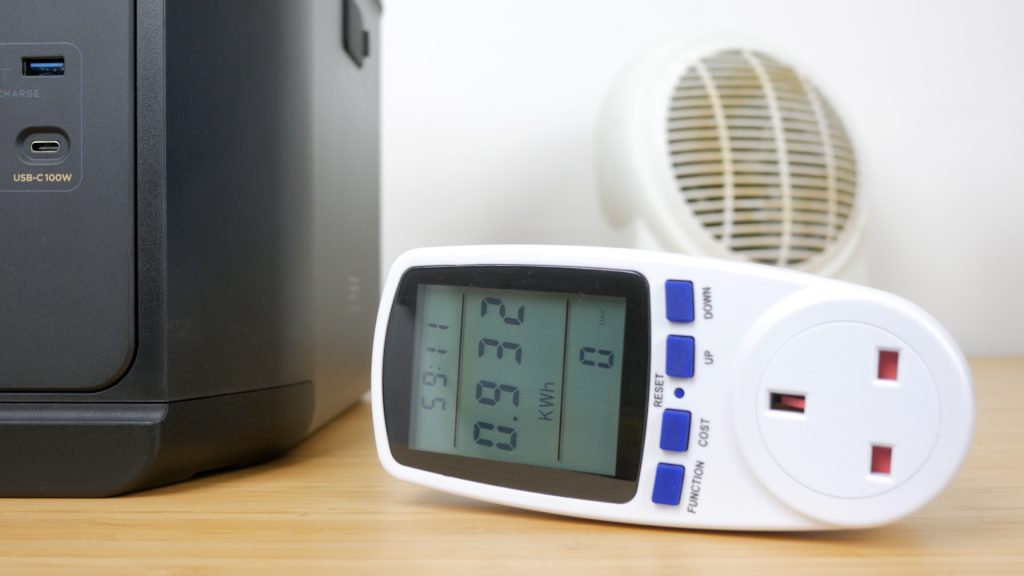
Finally I measured the usable capacity of the 1024 Wh built-in battery. I ran a heater via an energy monitoring plug at around 1000W until the power station turned off. The heater ran for 59 minutes and 11 seconds and consumed 932 Wh. Power stations like this will always have conversion losses and anything over 80% is pretty good. The EcoFlow works out at 932 Wh /1024 Wh which is around 91% and an excellent result.

I did a similar test using the DC output with a 10A electronic load attached. I measured 870Wh which is still a very respectable 85% efficiency.
https://thetechnologyman.com/